College and Beyond II (CBII) Study Guide
 The College and Beyond II Data Series is an extensive educational data collection, containing over 1 million student-level records and nearly 50 million course-level records from 2000 to 2021. It draws from 19 diverse public institutions across 7 university systems in the U.S., including 11 minority-serving institutions. The series features graduates’ perspectives on their college experiences and long-term outcomes a decade after graduation.
The CBII project was led by an interdisciplinary team at the University of Michigan and was supported by a grant from the Mellon Foundation, as part of the Mellon Research Forum on the Value of Liberal Arts Education.
CBII data can be used to answer questions like:
- What courses do students choose to take and what influences these choices?
- What content are students exposed to in the courses they take and how does this differ by student background?
- How do college course-taking and extracurricular experiences relate to long term life outcomes?
- How do alumni describe the impact college had on their lives?
CBII Participating Institutions:
City University of New York, Georgia College and State University, Indiana University-Bloomington, Truman State University, University of California Irvine, University of Houston, and University of Michigan.
Accessing CBII Data in the Virtual Data Enclave
1. Submit Application
Note: collaborations require separate Restricted Data Use Agreements for each institution.
On a CBII study homepage, click “Access Restricted Data” to enter VDE Manage, the online system where you can submit your application. The application requires:
- Principal Investigator (PI) information (PI must hold a PhD or terminal degree, and a faculty or research position.)
- Abstract
- Research Description (In 700 words or less)
- The research questions, problems, or issues your research will address
- A description of the data you plan to use in your research
- IMPORTANT: You must provide an explanation about how the research will contribute to improving educational instruction.
- Restricted data selections

2. Receive Confirmation & Download an RDUA
ICPSR will email you a confirmation when your application is received, including a link to download an RDUA.
3. Email Required Documents
To complete your application, email [email protected] your signed RDUA (signed by PI and a PI’s institutional representative) and IRB determination.
4. Application Review and Approval
ICPSR reviews and approves your application. The application can be sent back to the applicant if further work is necessary. Note: since the agreement for CBII data requires ORSP countersignature, approval may be delayed until ICPSR receives the fully executed agreement from ORSP. This process can take two weeks or longer.
5. Purchase License(s)
Return to your application to purchase annual VDE licenses for your research staff.
6. Assign Licenses
Return to your application to assign purchased VDE license(s) to your research staff.
7. Complete VDE Training
All team members must watch a VDE training video and complete a quiz.
- Watch the ICPSR VDE Training video
- Complete the VDE Training Quiz. If you answered any of the quiz questions incorrectly, please rewatch the video and consult the VDE documentation.
8. Email Your Quiz Score
Email [email protected] to notify ICPSR staff that you have completed the VDE training and passed the quiz.In your email, include your name, VDE Project number, and the e-mail address you provided in the training quiz so that we can verify your training completion.
9. VDE Set Up
ICPSR sets up user accounts for your research staff and creates a space for your project in the VDE.
10. Receive Instructions for Access
Instructions on activating a Duo Two-Factor Authentication account, downloading the VMWare software (Omnissa in Windows) needed for accessing the VDE Management System, and logging in and navigating within the VDE Management System.
11. Access CBII Data
Access your project’s folder in the VDE containing the requested restricted data.
Permitted Uses of CBII Data
- CBII data can only be used for research studies aiming to improve instruction.
- On the online application, applicants must provide an explanation about how their research will contribute to improving educational instruction.
Restrictions on Institution Identification and Comparison
- Per the RDUA, institutions shall not be identified in published results or presentations. Also, researchers must not attempt to deduce the identity of institutions associated with individual records in the restricted data, unless the project received a written approval from ICPSR to conduct a study that uses institutionally-identified data.
As shown in the diagram below, the CBII Data series includes core administrative data (student, term-level, and course transcript information), alumni survey data (both structured and open-ended responses), and additional studies on topics such as institutional context, advanced placement, enrollment, student analytics, and course content.
The student records in CBII data are linkable to additional data, such as qualitative data on the content of students’ courses, survey data on graduates’ long-term life outcomes, and National Student Clearinghouse data on educational attainment. CBII is more than just a collection of data files– it is a data infrastructure that can be leveraged to learn about many facets of students’ experiences in college. Future data enhancements will expand the range of what researchers can learn.
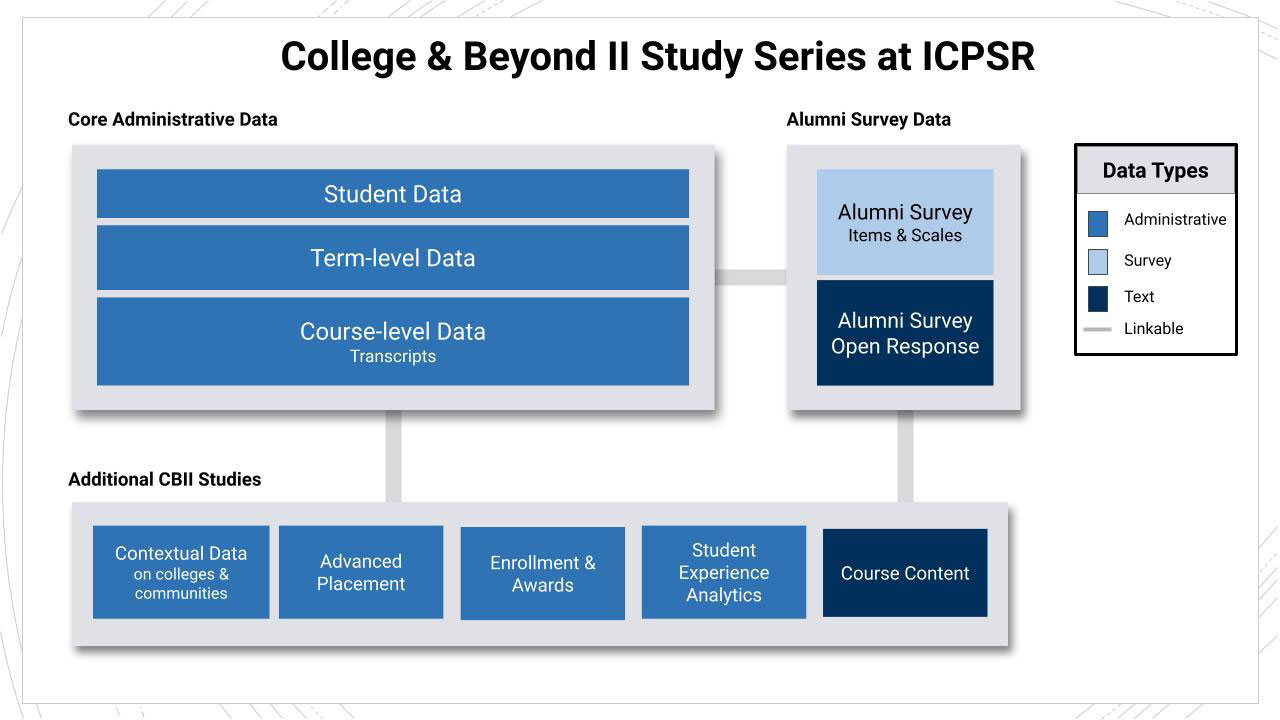
 The CBII Data series consists of eight studies that can be linked together to answer a wealth of research questions. Each study contains de-identified data files on a common topic or from a common data source.
CBII Studies:
- The Administrative Data serves as the core of the CBII series. It contains student record and transcript data on bachelor’s-seeking undergraduates enrolled at 19 institutions nested within seven different postsecondary systems. The data spans from approximately 2000-2021 and contains records for over 1.3 million students.
- The Alumni Survey measures later-life outcomes and impressions of the college experience approximately a decade after bachelor’s receipt for a subsample of students in the Administrative Data. Survey respondents graduated during academic year 2009-2010 and took the survey in 2021. Review the survey questionnaire (pdf).
- The Alumni Survey Open Response study contains written accounts from Alumni Survey respondents about the college experiences that had the greatest impact on their professional and personal development.
- Enrollment and Awards data contains information about students’ periods of enrollment and awards earned (e.g., degrees, certificates) at institutions that report data to the National Student Clearinghouse.
- The Course Content study contains information about courses listed in students’ transcripts, including text descriptions of course content from college and university catalogs and standardized subject codes.
- Advanced Placement (AP) data contains information on student-level Advanced Placement test results and course credit received.
- Student Experience Analytics are summary measures of the student experience created by researchers using the CBII data. They include measures of curricular breadth and depth and course-level peer diversity.
- The Contextual Data provides publicly-available data from two studies that can be used to contextualize students’ experiences: the Integrated Postsecondary Education Data System (IPEDS) and the National Neighborhood Data Archive (NaNDA).
CBII Study Documentation:
When working with CBII data in the VDE, researchers may find the following resources helpful:
CBII Studies:
- Flaster, A., Stange, K., Paulson, A., Manley, K., & Courant, P. (2022, March). Can higher education foster career adaptability? (pdf) Paper presented at the Association for Public Policy Analysis and Management Conference, Austin, TX
- Paulson, A.. (2022). Measuring breadth and depth of study using neural embeddings (pdf). Working paper prepared for the 2022 American Educational Research Association annual meeting
CBII Presentations:
- College and Beyond II: A New Data Resource for Studying Higher Education
- 2020–2022 CBII Liberal Arts and Life Colloquium Series:
The series examined the values, dimensions, and measurable outcomes of a liberal arts education. Recordings are available on the 2021-22 and 2020-21 Colloquium Series pages.