Restricted Data at NACJD
NACJD takes extensive precautions to avoid violations of confidentiality and privacy for survey respondents and study participants.
Overview
Before we release datasets to the public, our staff checks them for content that might violate the confidentiality of survey respondents and study participants. Confidentiality considerations apply to a variety of data, including personal interviews, observation records, notes, recordings, organizational and institutional data, location or geospatial coordinates, and public records. We ensure confidentiality by removing, masking, or collapsing direct or indirect identifiers in public-use data. However, some of our datasets are not available for download because a risk of de-identification remains (e.g., individuals can use variables in combination or link datasets to other data files to infer a respondent’s identity).
When disclosure risks exist, we provide data through one of four restricted access mechanisms.
Evaluating Datasets
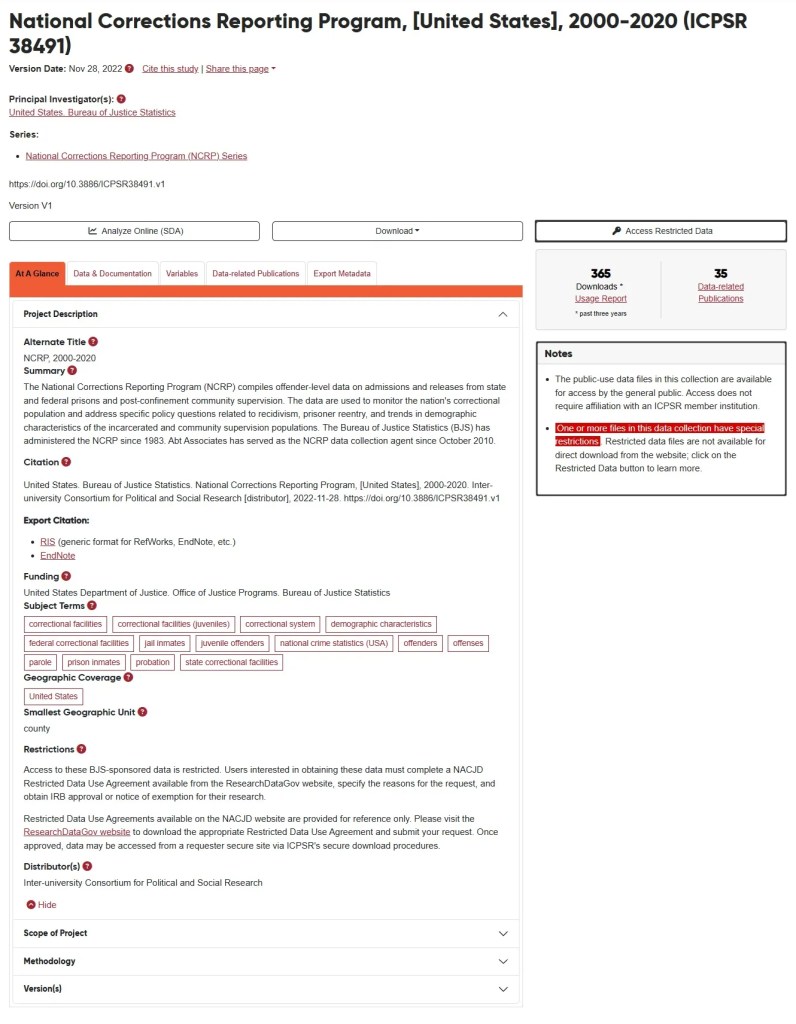
In most cases, documentation describing datasets remains available on study homepages. Documentation includes descriptive study-level metadata, as well as codebooks, questionnaires, user guides, and supporting documentation prepared for use with the study. Before applying to access restricted datasets, we encourage applicants to review documentation files. Restricted-use studies (or parts of studies) are indicated on the study homepage under the “Notes” section, as well as by an “Access Restricted Data” button underneath the study title as shown below.