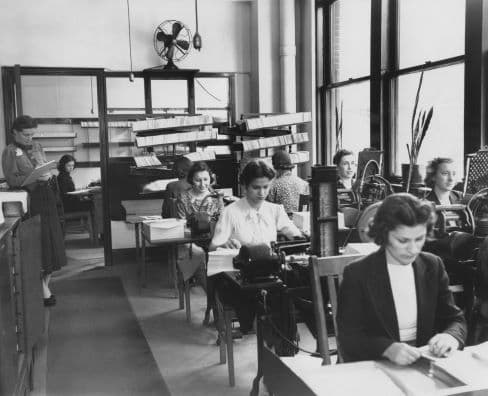
Race and gender: Working conditions of Black and White women
Historical census data play an important role in the study of the history of women’s work. From this body of data emerges the first topic of this Spotlight: how both race and gender were determinants of the work women did. For her study United States Southern Cities in 1870 and 1880: A Study of Individuals and Families (ICPSR 7568), Claudia Goldin used the census data collected from the 1870 and 1880 manuscript schedules to characterize individual and family life in seven Southern cities. Based on these data, Goldin looked at the differences between Black and White women’s labor force participation during the period right after emancipation (Goldin, 1977). She found remarkable differences in labor force participation between the two groups: on average, Black women were three times more likely to work than their White counterparts, and the rate of this difference increased to almost six times in the case of married women. By 1880, 73.3 percent of single Black women participated in employment, which was an increase by 10 percentage points as compared to their 1870 participation rate.
Black women were also highly represented in unskilled and low paying jobs, as laundresses, seamstresses, cooks or servants, since their job opportunities were limited by the lack of manufacturing in the Southern cities. Based on Goldin’s analysis, the differences between Black and White women’s labor force participation was substantial even for those who lived in similar circumstances, as measured by family income, wealth, and demographic characteristics. Goldin compares this phenomenon to Northern native-born women’s work participation. In the Northern states, immigration from outside the United States was an important factor, and the American-born women had lower labor force participation than the immigrant women, similarly to the White-Black disparity in the South.
One of the most notable historical data sources found at ICPSR is the Historical, Demographic, Economic, and Social Data: The United States, 1790-2002 (ICPSR 2896). Created by Michael Haines, this compilation of historical census data, including population censuses, censuses of manufacturing, religious bodies, and agriculture, is a widely used source of historical data.
Relying in part on decennial census data found in ICPSR 2896, Elman et al. 2019 looked at the lives of Black and White settlers in the frontier state of Arkansas. A contrast to the city life depicted by Goldin, Elman and co-authors provide an account of a state where racial laws were abolished and the increased freedom of movement brought settlers from varying ethnicities and races. Observing the state in the 1880s, the authors found great differences between the Upcountry, where families relied on subsistence farming, and the Plantation and Coastal Plains lowlands, which were more tied into commercial production and trade. Few of the Upcountry White women worked outside the home, as they almost all married young, and had lower literacy rates. Black women in the region also worked less than their counterparts in the lowlands of the state, and more often were employed in domestic occupations. They provided services in the form of tasks, which left more time to tend to their own households. By the 1910s, the relative freedom of Black women in the Upcountry decreased with the adoption of “sundown” laws and the state’s adoption of racial laws (Elman et al. 2019).
The young Black women living in the lowland areas with plantations were the most economically active females in Arkansas. White women in the region were also more likely to work compared to those in the Uplands and Coastal Plains. Married women with children were least likely to be employed. Those who had no children and had fewer close kin or lived in someone else’s house had a greater likelihood of working. Later, in the 1910s, a sharecropper system limited the upward mobility of Black women who wanted to acquire land, as the new laws prohibited them from ascending on the agricultural “ladder.” They were limited to being either workers on the plantations or “dependents” on their sharecropper husbands’ contracts.
Inequalities in pay and roles
While most women who worked at the time had to do so out of necessity, the 19th century also brought new opportunities for educated women outside the home. As Susan B. Carter wrote in her 1986 paper using Goldin’s data on United States Southern cities (ICPSR 7568), teaching was the primary occupation for educated women at the time. The abundance of female teachers contributed to an increasingly educated American population, but it came at the cost of wage inequality for women. According to Carter’s paper, 1870 was the first year for which cross-sectional, state-level data were available on the determinants of teachers’ wages. Based on Carter’s analysis, school boards tended to hire more female teachers on a lower salary and were able to restrict class sizes, as smaller class sizes meant higher overall attendance. The author argued that the limited employment opportunities of educated women, i.e., as teachers, contributed to the high level of school attendance and the resulting increase in the number of educated citizens in the late 19th century US, which in turn led to accelerated economic growth.
In her aforementioned book, Claudia Goldin conducted an extensive study of American women’s economic history. Goldin utilized the public use samples of the 1900 and 1910 censuses, as well as historical data that was later deposited at ICPSR as the Women and Child Wage Earners Series. Goldin used the Report on the Condition of Woman and Child Wage-earners in the U.S. in 19 Volumes, Vols. 86-104, published in 1910-1911, to create these datasets on the lives of working women and girls in New York City, Chicago, Philadelphia, North Carolina, and Massachusetts. These data represent information on working women in different circumstances who worked in the manufacturing industries. The 1907 report provided information on the earnings of women in the early 20th century. The biggest group, three quarters of working women, were young, unmarried women. The report also sampled working wives and widows, the remittances provided by wives and daughters to their families, and those who lived apart from their families to work in big cities.
Goldin’s (1990) findings suggest that women were working in jobs that required little training, therefore they didn’t gain many skills that could be applied in further employment. Young women started work at age 15 on average and often worked until they were married. There was a considerable gap between the wages of male and female workers, which was a result of differences in the necessary attributes required from men and women, as well as their work tenure, which allowed men to gain more experience. However, even when Goldin looked at a firm where all workers were paid by the piece, males earned 25 percent more than females.
Kitae Sohn (2015) also found an unexplained gender gap in earnings using Goldin’s and Larry Katz’s data based on the 1915 Iowa State Census. Sohn investigated the gender gap in teachers’ earnings in the early 20th century, with the caveat that the 1915 census reflected annual earnings, so part of it might have come from outside their teaching jobs. In the Iowa sample, 86.7 percent of teachers were female, which shows the feminization of the occupation already happening. The author found that there was a 25.6 percent gap in earnings unexplained by any of the considered characteristics of male and female teachers, be it experience, education, or location. This gap can be attributed to the nature of the job, since the measurement of teaching performance is more difficult, opening up the possibility of wage discrimination.
Unmarried daughters had a key role in the labor sharing of families. Sharon Sassler (1995) used the 1910 Census of Population Public Use sample (ICPSR 9166) to look at the assigned roles of co-resident working-age daughters in light of their family members’ presence and activities. In Sassler’s sample, more than half of co-resident daughters were gainfully employed (55.5 percent) and most of them were under the age of 20. Sassler noted the steep decline in school attendance between the ages of 15 to 17, which indicates the timing of their entering adulthood. Foreign-born daughters had a smaller likelihood of attending school than daughters born in the US, while young Black women were more likely to attend school than native- or foreign-born Whites. Sassler concludes that this could be attributed to either scarce work opportunities for young Black women or the value placed on education as opposed to domestic work in African American families. The greater the number of siblings were, the earlier the daughters transitioned into work either domestically or outside the home.
Sassler’s findings ran counter to previous findings in the literature on sibling trade-offs, which traditionally assumes that parents differentiated between siblings on the basis of sex, investing into sons over daughters and assigned different roles to same-sex siblings, based on economic need. However, as Sassler found, the effect that different siblings had on each other’s trajectories depended on multiple factors. If a daughter had a working sister or one in school, her likelihood of engaging in the same activities were greater. This highlighted how sisters were treated equally in a family, based on not only financial need but also on what that particular family valued. On the other hand, the presence of working or studying brothers significantly increased the daughter’s domestic work in the home, and the presence of small children also had the same effect.
The differences in young men’s and women’s wages could affect their families’ lives, especially as most young people lived at home and gave their earnings to the household. Trevor Logan used the Cost of Living of Industrial Workers in the United States and Europe, 1888-1890 (ICPSR 7711) data (referred to as “1888CEX”) as the main resource for his 2022 book chapter (Logan, 2022) to account for the earnings and consumption patterns of families in the era. Logan also used the Women and Child Wage Earners data as compiled by Goldin to confirm part of his results on the wages of young people. This chapter looks at the intrahousehold allocation of resources in the 19th century and the efficiency of this allocation, especially as it pertains to gender. Logan looked at the distribution of different consumption goods in the family, such as the “public” and “private” goods, which in this case meant if the whole family or only a certain member had access to those goods, as well as specifically adult goods, such as tobacco, alcohol, and clothing for the parents. The 1888CEX data was also used to assess the differences between pay among working boys and girls.
The author found that the equitable allocation of resources regardless of gender was the most efficient allocation, meaning that the parents did not take into account which children would earn more or less over their lifetimes. However, this was not the result of parental egalitarianism or altruism, but rather of strategic decisions. Young boys would earn more, especially those who worked in the steel and iron industries, but were more likely to leave the household. At the same time, young girls were expected to do more household chores, which increased their value to the family unit, along with the greater likelihood of their staying with the family.The families had to allocate the same amount of resources to children in the face of an uncertain future, despite the gender gap in earning.
Women in the heartland: Work during the world wars
The first and second world wars shook the usual economic order and changed the economic role of women, leading to rearrangements in their opportunity structure. Using historical data from the 1910 population census found in ICPSR 2896 and data on agricultural commodities in the United States Agriculture Data, 1840-2012 (ICPSR 35206), Kitchens et al. 2020 explored connections between the income shocks and the decrease in fertility rates in the period between 1910–1930. World War I brought an unexpected agricultural commodity boom in the United States, doubling the export of agricultural products at higher prices, which was followed by a sudden bust in the same sector after the war. Kitchens and co-authors concluded that the great shock of the agricultural boom-and-bust significantly impacted the opportunity cost of female employment and their subsequent fertility. The greater the price shock was in an impacted county, the greater the decline in fertility that followed. Women who lived in rural areas were motivated by higher agricultural prices to enter the workforce and delay marriage, which had long-term consequences on the number of children they had.
Bose et al. 2020 utilized the Haines historical, demographic and social data to assess the relationship between women’s labor force participation and the adoption of household technologies. The authors used female labor force participation data from the 1940 and 1950 censuses; the ownership of refrigerators served as a proxy for household technology adoption. They also looked at Department of Defense data on WWII factory locations to account for the demand for women’s labor during the war mobilization. The authors established that the exogenous shock of war mobilization during the second world war was associated with the adoption of household technology. Their effects were especially significant for less educated women, who benefited more from their earned income and were thus able to purchase appliances. The opening up of new opportunities for women who previously worked in domestic labor in wealthier households also contributed to the spread of household appliances.
Conclusion
Claudia Goldin ends Understanding the Gender Gap by emphasizing the importance of understanding the economic inequality of the past to engineer a better future. She contends that while economic progress in itself fosters a more equitable labor force, there is a need for legislation and social change to assist the process. The present Spotlight is not meant to be an exhaustive overview of all aspects of women’s economic history of the pre-WWII United States, but rather a tool to start an investigation. To see how each of the ICPSR studies mentioned in this Spotlight has been examined in other scholarly literature, to gain ideas for extending prior research, or to conduct a larger literature review, you can search the ICPSR Bibliography of Data-related Literature. Using search terms like “female labor force participation,” “female labor force” or “women AND work” will lead you to search results containing publications linked to the study data analyzed in them. Discovering data via the literature in this way can begin your investigation of the existing and potential uses of the data distributed by ICPSR.
When authoring publications that include your secondary analysis of study data downloaded from ICPSR, be sure to cite the study in the publication’s references section, using the provided data citation and unique identifier (in the form of a URL containing a DOI). Once your paper is published, submit its citation to the ICPSR Bibliography via this form, so it can be added to ICPSR’s collection of linked data-related literature, enabling others to find, learn from, and cite your work.