Improving survey measures of time and money help given and received due to hardships of the COVID-19 pandemic
Principal Investigator

I-Fen Lin, Professor of Sociology, Bowling Green State University
Principal Investigator
Judith Seltzer, Research Professor, Department of Sociology, University of California Los Angeles
The problem:
The 2020 Health and Retirement Study (HRS) included a COVID-19 Module, wherein respondents were asked about time they gave and/or monetary help they received in response to the pandemic, but the public data only identify support from children or those who lived with respondents.
With permission from the HRS, the research team accessed confidential data to identify all members of respondents’ support networks. This paper describes the new variables the researchers created and illustrates their value for examining differences in support between older adults with and without a spouse/partner and children.
The approach:
Lin and colleagues coded 5,499 verbatim responses to four questions regarding time and money received and given from 4,013 respondents in the HRS COVID-19 Module to create new variables indicating each helper’s or recipient’s relationship to the respondent. Inter-coder reliability was high across all relationship categories.
So-called kinless older adults, that is, those without a spouse/partner and without children, were as likely as their non-kinless counterparts to engage in transfers, but exchanges with nonkin were more common among kinless older adults. Among those who engaged in any exchanges, kinless older adults were three times more likely to receive money help from nonkin and twice as likely to receive time help from nonkin. They also were twice as likely to give money help to nonkin, and 1.5 times more likely to give time help to nonkin.
Despite being labeled as “kinless,” these older adults were more likely to engage in transfers with siblings compared to their non-kinless counterparts.
The findings:
As the number of kinless older adults continues to rise in successive birth cohorts, surveys must capture a broader support network. These findings highlight the importance of considering relationships beyond adult children, such as siblings and nonkin, in the HRS.
Moreover, questions that ask specifically about exchanges with nonkin will enrich HRS content on material social support.
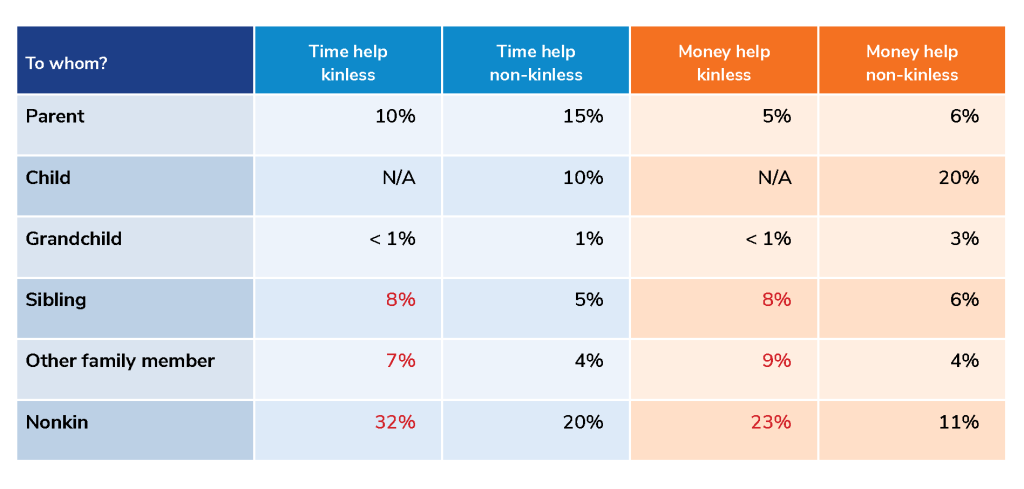
Table showing the percentages of time and money help provided to or received from different recipients (Parent, Child, Grandchild, Sibling, Other family member, Nonkin) by kinless status among respondents who engaged in any exchanges. There are four columns: Time Help Kinless, Time Help Non-kinless, Money Help Kinless, Money Help Non-kinless. For parents, time help is 10% (kinless) and 15% (non-kinless); money help is 5% (kinless) and 6% (non-kinless). For children, time help is not applicable (N/A) for kinless and 10% for non-kinless; money help is N/A for kinless and 20% for non-kinless. For grandchildren, time help is <1% for both groups; money help is <1% (kinless) and 3% (non-kinless). For siblings, time help is 8% (kinless, in red) and 5% (non-kinless); money help is 8% (kinless, in red) and 6% (non-kinless). For other family members, time help is 7% (kinless, in red) and 4% (non-kinless); money help is 9% (kinless, in red) and 4% (non-kinless). For nonkin, time help is 32% (kinless, in red) and 20% (non-kinless); money help is 23% (kinless, in red) and 11% (non-kinless). Red text highlights higher percentages for kinless individuals in selected rows.