Optimism and risk perceptions in response to rapidly evolving health risks
Principal Investigator
Anna Chupak, Ph.D. Candidate, Department of Health Promotion, Education, and Behavior, University of South Carolina
Co-Investigators
- Caroline Rudisill, Professor, Department of Health Promotion, Education, and Behavior, University of South Carolina
- Joan Costa-Font, Professor, Department of Health Policy, London School of Economics
Funded By
Social, Behavioral, and Economic COVID Coordinating Center (SBE CCC)
The Problem
The COVID-19 pandemic offers an opportunity to investigate how individuals use perceptions of known and emerging risks to inform decision-making. Because optimism can offer realistic or unrealistic depictions of risk, the researchers in this study aim to explore how these perceptions evolve when viewed with optimism and how optimism (realistic or unrealistic) evolves in a setting of uncertainty for both known and new risks.
The Approach
The research team partnered with IPSOS MORI to survey U.S. residents in July 2020 and May 2023. Sampling weights were used to produce nationally representative estimates.
Bivariate probit specifications jointly analyzed associations between risk perceptions for flu, COVID-19, and food poisoning, and vaccination intentions for flu and COVID-19. We also estimated ‘private optimism’ (realistic optimism) using factors known to predict optimism (e.g., age and physical health status), tested estimated ‘private optimism’ vs. survey-reported optimism in bivariate probit specifications, and examined how findings varied during and post-pandemic.
The Findings
From 2020 to 2023, personal and average person risk perceptions about becoming infected remained the same for flu, declined for COVID-19, and increased for food poisoning.
While optimism bias was associated with vaccination intentions during and after the COVID-19 pandemic for flu and COVID-19, ‘private optimism,’ was a superior estimator of the role of optimism in response to a known and a new risk.
Optimism about both known and new risks may be an important tool to leverage in encouraging health promoting behaviors because of demonstrated responsiveness to new information about risks.
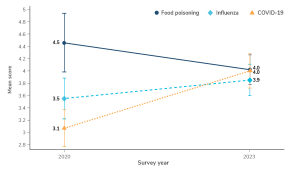
A line graph titled “Change in Survey-based Optimism Indices (2020 & 2023): Weighted t-Test Analysis,” showing mean optimism scores for three health conditions (Food Poisoning, Influenza, COVID-19) in 2020 and 2023. The y-axis represents mean scores (ranging from 2.8 to 5), and the x-axis represents survey years (2020 and 2023).
Food Poisoning (black circles, solid line): starts at 4.5 in 2020 and decreases to 4.0 in 2023.
Influenza (blue diamonds, dashed line): increases from 3.5 in 2020 to 3.9 in 2023.
COVID-19 (green triangles, dotted line): increases from 3.1 in 2020 to 4.0 in 2023.
Error bars show variability in scores. A legend in the lower center identifies each condition’s symbol and line style. Overall, optimism increased for Influenza and COVID-19 but decreased for Food Poisoning over the survey years.