Friend of ICPSR: Cecelia Lasley
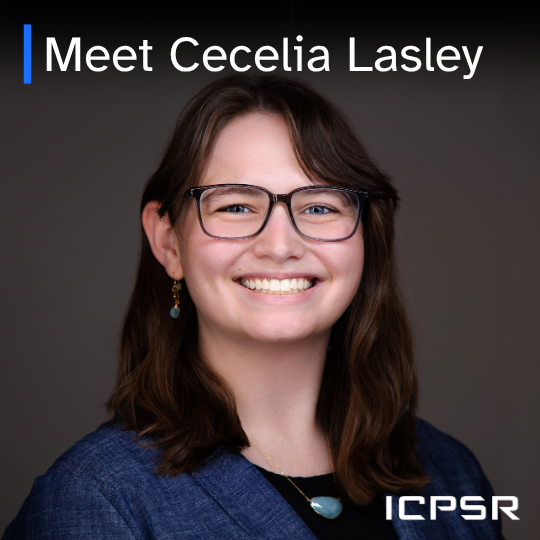
Meet Cecelia Lasley, a Research Librarian at Tufts University, where she supports departments ranging from Anthropology to Economics to Sociology. Working with ICPSR, Cece makes data feel a little less intimidating. She loves ICPSR’s mix of rich datasets, practical learning, and genuinely supportive community. When not talking data, she is often embroidering, baking, or hanging out with her rescue dog, Roo.
 Where do you work and what is your job title?
Tufts University, Research Librarian for the Social Sciences
What is a favorite memory or instance you have working with ICPSR? What makes ICPSR a great place?
ICPSR has an incredible sense of community. It was amazing how quickly we all bonded during “Providing Data Services from Surviving to Succeeding,” despite being scattered across every North American time zone and two countries. Many of us have stayed connected through a monthly community of practice where we discuss how our libraries are handling common challenges, share other professional development opportunities, and learn from each other’s experiences. It’s something that I look forward to each month!
Where are you from?
Severna Park, Maryland
What is your favorite part of working with ICPSR?
My favorite part of working with ICPSR is a tie between the breadth of the subject matter and the level of detail provided in the ICPSR datasets. I support six different departments as a liaison librarian (Anthropology, Child Study and Human Development, Economics, Education, Psychology, and Sociology), so having such a wide range of subjects within ICPSR means that I can frequently find something relevant to use in my classes. The level of detail in the ICPSR datasets and their codebooks make them amazing teaching and research tools.
What’s one ICPSR dataset you find fascinating, unusual, or you’ve had a hand in getting deposited?
The “The Expanding Children’s Early Learning (ExCEL) Quality Study: Improving Preschool and Early Care and Education (ECE) Instruction through Curricula, Coaching, and Training, United States, 2019-2021” dataset is a really fascinating resource because it focuses on a critical age of human development (preschool) and the period of change that accompanied the pandemic. I really hope to use it in a class soon!
How long have you worked with ICPSR?
I’ve been working with ICPSR for about 2 years.
What do you do when not at work?
I enjoy embroidery, baking, and spending time with my rescue dog, Roo.
What have you read/viewed/listened to/etc. recently?
I have been really enjoying watching the PWHL (Professional Women’s Hockey League) recently. Go Fleet!
What might surprise us about you?
I was very involved in technical theater (lighting design, stage management) in high school and college.
Anything else that you’d like to share with us?
I am so grateful to have been a part of the 2025 “Providing Data Services from Surviving to Succeeding” class. It is funny to admit on ICPSR’s website, but I was afraid of working with data prior to this class. As an English major and generalist librarian learning to focus on social sciences, data reference and instruction loomed large as massive skillsets that I felt under-equipped to handle. “Providing Data Services from Surviving to Succeeding” was an intensely practical, immersive experience that helped me feel at long last equipped to support data reference and instruction. Instructors Barbara Esty, Julie Marcoux, and Stephanie Labou leveraged the breadth of their roles and expertise within data librarianship to be comprehensive while remaining rooted in practical applications. Barbara led discussions around collection development and gave advice regarding licensing negotiations. Julie helped us think more programmatically about reference, instruction, and outreach while also coaching us on setting boundaries. Stephanie facilitated discussions about the impact of our changing data landscapes on instruction and broke down different methods of analysis support. Our cohort contained a wide range of experience, from established data librarians to those, like me, who recently began supporting data services. This range of experiences, roles, and institutions (from small liberal arts colleges to ARL libraries) allowed us to learn from each other as well as from Barbara, Julie, and Stephanie.
The two-week format allowed me to focus solely on our coursework and how I could apply it at Tufts rather than juggling class with my normal day-to-day tasks. Fortunately, I had a concurrent opportunity to apply the data literacy instruction skills I was learning in class, as part of Tisch Library’s summer project to refine our instruction program. My colleagues and I reworked one of my data instruction lesson plans, which I was able to use for my ICPSR capstone project. I taught the revised lesson several times during the Spring 2026 semester, and it was well received by faculty and students. It has been so exciting to feel more confident in this aspect of my teaching this academic year and to see the effectiveness of what I learned. The lessons from this class helped me co-initiate an ongoing internal data collections review, with the goal to enable more proactive data collections decisions. One of the least expected but most valuable opportunities from this course has been the continued support beyond the class. Barbara, Julie, and Stephanie convened a community of practice through the fall and cohort members have continued organizing monthly meetings. This recurring space has allowed us to maintain our cohort’s community, as well as share conference opportunities (I presented at a conference I hadn’t even heard of before this class!), get help on tricky reference questions, and continually learn from each other. Outside of this community of practice, I hope to continue learning through other ICPSR summer classes in the future. I also hope that other newcomers to data librarianship have the opportunity to take “Providing Data Services from Surviving to Succeeding.”

Thanks, Cece!
Want to join our team?
Interested in being featured?
Representatives, data depositors, and other members of the ICPSR community are invited to fill out a 10-minute questionnaire (choose the one appropriate to your role): Representatives & Friends form, Depositors form, Researchers form, and Staff form. Please note that submission does not guarantee selection.